


Holding yellow banners and clutching sunflowers, thousands took to the streets in Taipei yesterday as part of a nationwide “430 Sunflower No Nuke Action” protest, urging the government to stop construction of the Fourth Nuclear Plant in Gongliao District (貢寮), New Taipei City (新北市), and pursue a more sustainable energy policy.
With “smile at the sun, keep away from nuclear disasters” as the theme of the parade, yellow flowers were picked to symbolize sustainability. Some also held handmade paper windmills, symbolizing green energy and a bright future without the fear of a potential nuclear crisis.
The nation’s anti-nuclear movement gained new momentum in the middle of March after a massive earthquake struck Japan and unleashed a tsunami that damaged the Fukushima Dai-ichi nuclear power plant, causing radiation to be released, which has endangered northeastern Japan’s food and water supplies.
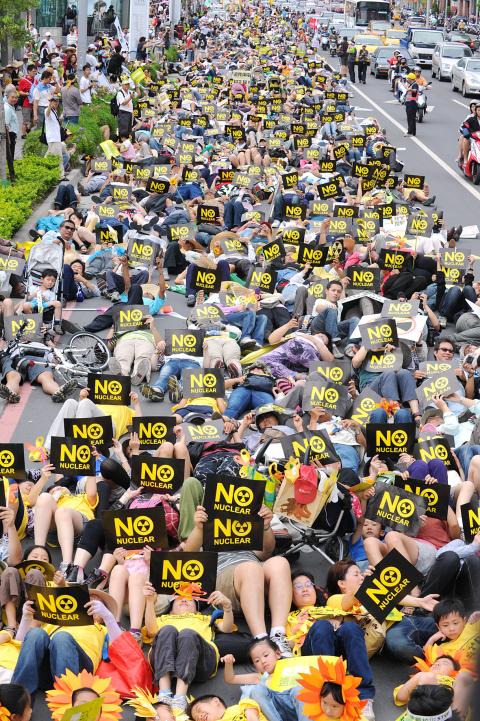
Photo: Huang Chih-yuan, Taipei Times
The disaster resonated especially strongly in Taiwan because, like Japan, it is prone to earthquakes that could lead to scenarios similar to those that crippled the Japanese plant.
People of all ages took part in the carnival-like parade yesterday.
A section of the parade, called the “Keep Away from Nuclear Disaster Division,” was led by about 20 people holding up a long yellow banner with the words “No Nukes” written on it, followed by a group of protesters wearing radiation protection suits to remind people about the potential severity of nuclear disasters.
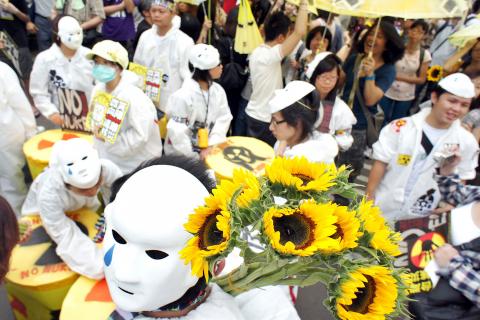
Photo: CNA
Another section was -comprised mostly of students from several universities.
Young people dressed in colorful clothes danced to music as they shouted anti--nuclear power slogans and paraded through the bustling streets.
“I think the government should replace nuclear power with other safer energy sources,” said a mother surnamed Chang (張), who stood on the sidewalk with other parents and children for a short break during the parade.
She said she wanted her daughter, who is in the first grade, to take part in the parade because they had been taught about nuclear power issues at school, and her daughter was happy to participate.
A student from an Aboriginal Tao village on Orchid Island (蘭嶼), where a nuclear waste storage facility is located, said the Tao people believed that nuclear radiation, which has no form or color, is like evil spirits and must be banished.
This inspired him to wear a traditional Tao warriors helmet made out of paper to symbolize fighting off evil spirits.
A 35-year-old woman surnamed Chen (陳) was dressed in a wedding gown and said that while the government is concerned about the nation’s low fertility rate, “we don’t want to get married and raise our children in such a dangerous environment.”
“After the Fukushima nuclear crisis, I think there are some things that are non-negotiable,” she added.
At one point, the crowd lay on the ground, pretending to be dead, after a simulated nuclear leakage siren sounded.
The display, called “If that day comes,” symbolized the many people that could die in Taiwan if a nuclear crisis were to unfold, the organizer said.
Appealing to the government to map out retirement plans for the nation’s three operational nuclear power plants, to put an end to the construction of the Fourth Nuclear Power Plant and to create a nuclear-free homeland where everyone can live without fear of a nuclear disaster, the protesters shouted slogans such as, “Cherish life, end nuclear power,” and “I want a nuclear-free homeland.”
Their two-and-a-half-hour parade eventually led them to the Presidential Office on Ketagalan Boulevard.
Two Japanese, Ono Saiko and Oga Ayako, who said they were forced to leave their homes in Fukushima Prefecture because of the nuclear crisis, joined the parade in Taipei and shared their thoughts with the crowd.
“The Fukushima nuclear crisis is still going on in Japan; we are not in the mood to find fault with the cause, but we are facing a problem of how are we to protect our next generation,” Saiko said.
She said that she hopes people in Taiwan can join forces with people in Fukushima and take nuclear problems more seriously.
Oga Ayako said she saw “hope and power” in the protest in Taipei, and hopes that the next time they are in Taiwan it will be a nation free from nuclear threats.
Organizers estimated that at least 5,000 people turned out for the protest in Taipei, but no police figure was immediately available.
Additional reporting by AFP and CNA

The National Chungshan Institute of Science and Technology yesterday showcased its locally developed variants of the Vision 60 robotic patrol dog, which it plans to deploy on the nation’s outlying territories in the South China Sea. The variants were produced under the Joint Lab project — created by the institute and domestic companies — and assembled with domestically produced motors, lenses and artificial intelligence (AI) systems alongside licensed tech from the US, Missile and Rocket Systems Research Division deputy director Jen Kuo-kang (任國光) told the media event at a military base in Taipei’s Dazhi (大直) area. Taiwan has built up its strengths

RIGHT DIRECTION: Taiwan’s efforts to prevent forced labor include a proposal to ‘fully prohibit’ employers from withholding workers’ documents, an official said Taiwan is to establish a mechanism to restrict imports of goods linked to forced labor, the Executive Yuan said yesterday, after the US proposed imposing additional tariffs on Taiwanese goods over labor concerns. “The Ministry of Labor and the Ministry of Economic Affairs are to establish an interministerial review procedure,” Executive Yuan spokesperson Michelle Lee (李慧芝) said at a news briefing in Taipei. “The government is to use the Foreign Trade Act [貿易法] as the legal basis to restrict imports of goods produced with forced labor” and bring its supply chain governance more in line with international standards on human rights, resilience

NOT IMMEDIATE: Taiwan has a chance to appeal the proposed 10 percent tariff before it starts, while other countries face a 12.5 percent tariff from the trade office Taiwan is among 60 economies determined by the US to have failed to impose or enforce a ban on the importation of goods produced with forced labor, according to a notice released on Tuesday by the Office of the US Trade Representative (USTR), which proposed imposing an additional 10 percent or more tariff on them. The USTR in a statement said that following an investigation, it had determined under Section 301 of the Trade Act of 1974 that the failure of the 60 economies to impose and effectively enforce a prohibition on the importation of goods produced with forced labor is

TIT-FOR-TAT: The US allegedly revoked the visa of a Chinese national working at Xinhua News Agency in the US in response to Beijing’s expulsion of Vivian Wang The Presidential Office yesterday condemned China for expelling a New York Times correspondent from Beijing following the newspaper’s interview with President William Lai (賴清德), saying the move highlighted Beijing’s suppression of press freedom and its threat to international news media. Taiwan has noted a series of recent incidents in which Beijing used similar tactics to “threaten and pressure international media outlets and journalists,” Presidential Office spokeswoman Karen Kuo (郭雅慧) said in a statement. “This concerns not only press freedom and freedom of expression, but also the safety of journalists, and Taiwan and relevant partners are paying close attention to the situation,” she


 RSS
RSS